- All
- Product Name
- Product Keyword
- Product Model
- Product Summary
- Product Description
- Multi Field Search
Views: 0 Author: Site Editor Publish Time: 2025-11-17 Origin: Site
From crisp bottled water to complex craft beers, the one ingredient that defines every beverage is water. The quality of this fundamental component dictates not only the final taste, safety, and consistency of the product but also the overall efficiency and sustainability of the entire production plant. For beverage manufacturers, treating water isn’t just a preliminary step; it’s a strategic process that safeguards brand reputation and ensures operational excellence.
Poorly managed water treatment can lead to off-flavors, product contamination, and costly equipment damage from scale buildup. Furthermore, with increasing regulatory pressure and a growing consumer demand for sustainable practices, effective water management has become a critical pillar of modern beverage production. This means not only purifying incoming raw water but also responsibly handling wastewater to minimize environmental impact and reduce operational costs.
This comprehensive guide will walk you through everything you need to know about selecting the right industrial water treatment equipment for your beverage plant. You will learn about the unique water challenges in the industry, the different types of water required, the key treatment processes involved, and a step-by-step framework for making an informed equipment choice.
Table of Content
What Is Industrial Water Treatment Equipment?
Understanding Water Challenges in Beverage Manufacturing
Types of Water Used in Beverage Plants
Key Water Treatment Processes Used in Beverage Plants
Industrial Water Treatment Equipment Used in Beverage Plants
How to Choose Industrial Water Treatment Equipment
Comparing Water Treatment Solutions
Common Mistakes to Avoid
How to Work With a Water Treatment Supplier
In the context of beverage production, industrial water treatment equipment refers to a range of specialized systems designed to purify, soften, filter, and disinfect water to meet the stringent quality standards required for food-grade applications. This process goes far beyond the scope of municipal water treatment, which primarily focuses on making water safe for general public consumption.
While municipal treatment removes basic contaminants, industrial systems for beverage plants are engineered to achieve specific water chemistry tailored to the final product. For example, the mineral content suitable for a soft drink differs vastly from that required for a smooth, clear spirit.
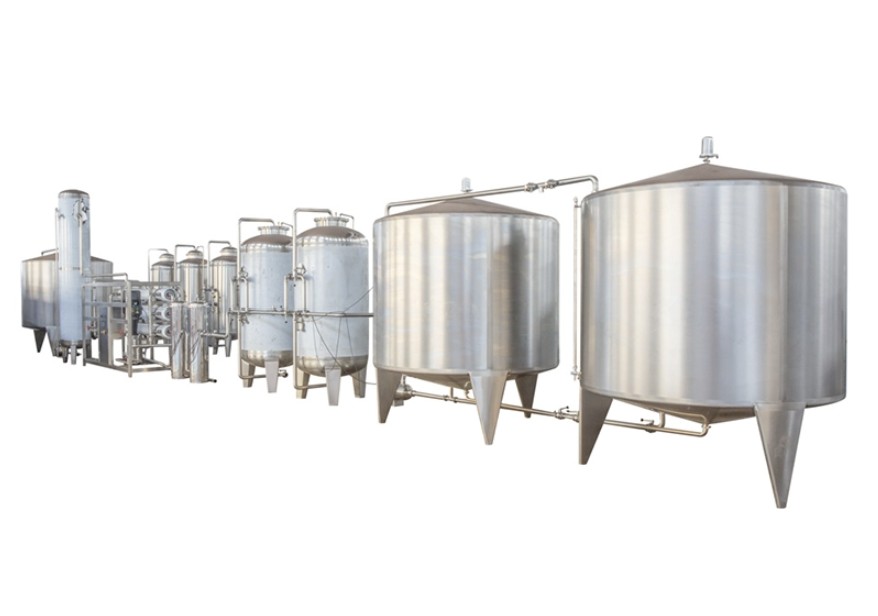
Water Treatment Equipment Beverage Drinking Water Production Line
The core objectives of industrial water treatment in the beverage sector include:
Purification: Removing dissolved solids, chemicals, and organic compounds that affect taste and odor.
Softening: Reducing water hardness (calcium and magnesium) to prevent scale buildup in pipes and machinery.
Filtration: Eliminating suspended particles, sediments, and microorganisms to ensure clarity and safety.
Recycling: Treating wastewater so it can be reused for non-critical processes like cleaning, reducing overall water consumption.
Discharge Compliance: Ensuring that any water discharged from the plant meets local environmental regulations.
Beverage companies navigate a complex landscape of challenges related to water. These challenges influence every aspect of production, from raw material sourcing to final product packaging.
The food and beverage industry is held to exceptionally high standards. Agencies like the U.S. Food and Drug Administration (FDA) and equivalent international bodies mandate that water used as an ingredient or in direct contact with products must be free from contaminants. Failing to meet these food-grade water quality standards can result in severe penalties, product recalls, and irreparable damage to a brand’s reputation.
The quality of incoming “raw” water can vary dramatically depending on its source—be it municipal supply, groundwater (wells), or surface water (rivers and lakes). Common issues include high levels of minerals (hardness), sediment, organic matter, bacteria, and chemical residues like chlorine. Each of these impurities must be systematically removed to create a consistent, neutral base for any beverage.
Using improperly treated water poses significant risks:
Taste and Odor Issues: Unwanted minerals or organic compounds can impart undesirable flavors and smells to the final product.
Microbial Contamination: Bacteria, viruses, and other pathogens can compromise product safety and lead to public health crises.
Scale and Corrosion: Hard water causes mineral deposits (scale) to build up in boilers, pipes, and heat exchangers, reducing efficiency and leading to equipment failure and costly downtime.
Inconsistent Product Batches: Fluctuations in raw water quality can lead to variations between different production runs, affecting brand consistency.
Beverage plants generate significant volumes of wastewater, often containing sugars, acids, and cleaning agents. Municipalities typically levy surcharges on industrial users for discharging wastewater that exceeds certain pollutant limits. Effective wastewater treatment is crucial for meeting these standards and avoiding hefty fees.
Modern consumers and investors are increasingly focused on environmental, social, and governance (ESG) criteria. Beverage producers are under pressure to reduce their water footprint, and water recycling has become a key sustainability initiative. Advanced treatment systems allow plants to reuse a portion of their wastewater for applications like cleaning-in-place (CIP) or cooling towers, conserving this vital resource.
Not all water in a beverage facility serves the same purpose. Different applications have different quality requirements.
Ingredient Water: This is the water that becomes part of the final product. It must be of the highest purity, free from any taste, odor, or color. This often requires advanced purification like reverse osmosis.
Process Water: Used for various production steps like rinsing, pasteurizing, and dilution, process water must also be high quality to avoid contaminating the product.
Utility Water: This water is used for plant operations that don’t involve direct product contact. This includes water for boilers, cooling towers, and general cleaning. While its quality standards are less strict than ingredient water, it still requires treatment (like softening) to prevent equipment damage.
Recycled & Reclaimed Water: As sustainability becomes more critical, many plants are treating and reusing wastewater for non-potable purposes like equipment cleaning, floor washing, or irrigation. This practice significantly reduces a plant’s overall water consumption.
To transform raw water into a suitable resource for production, beverage plants employ a multi-stage treatment train. Each stage targets specific impurities.
Pre-treatment: This is the first line of defense. It often includes screening to remove large debris, followed by coagulation and sedimentation to settle out suspended particles.
Filtration: This stage removes finer particles. Common methods include sand filters for larger sediment and activated carbon filters to remove chlorine, organic compounds, and off-tastes. Cartridge systems provide a final polishing step.
Softening & Scale Control: Water softeners use an ion exchange process to remove calcium and magnesium, the primary causes of hardness and scale buildup.
Ultrafiltration (UF): UF systems use membranes with microscopic pores to block suspended solids, bacteria, and viruses, providing excellent microbial reduction.
Reverse Osmosis (RO): RO is a high-pressure membrane process that removes up to 99% of all dissolved solids, including salts, minerals, and organic molecules. It is the gold standard for producing pure ingredient water.
EDI/Deionization: For applications requiring ultra-pure water (e.g., certain spirits or functional beverages), Electrodeionization (EDI) or deionization (DI) systems are used after RO to remove the last remaining ions.
Disinfection: This final step ensures the water is microbiologically safe. Common methods include ultraviolet (UV) light, which destroys microbial DNA without chemicals, and ozone or chlorine, which provide a residual disinfecting effect.
Wastewater Treatment: To handle effluent, plants may use Membrane Bioreactors (MBR) to biologically break down organic waste, followed by RO and Advanced Oxidation Processes (AOP) to treat and recycle the water.
Based on the processes above, a typical beverage plant will utilize a combination of the following equipment:
Raw Water Treatment Systems: Often include large tanks for coagulation and flocculation, clarifiers for sedimentation, and initial screening units.
Filtration and Pre-filtration Equipment: This category includes multimedia filters (sand, gravel), activated carbon filters, and micron-rated cartridge filters.
Reverse Osmosis (RO) Systems: These skid-mounted systems consist of high-pressure pumps, pressure vessels, and spiral-wound membrane elements. They are central to producing high-purity ingredient water.
Ultrafiltration (UF) Systems: Similar to RO in design, UF systems operate at lower pressures and are primarily used for removing particulates and microorganisms.
Water Softeners: These units contain resin beads that capture hardness minerals and are regenerated periodically with a brine solution.
EDI/DI Units: These systems use ion exchange resins and/or electrical currents to polish water to the highest purity levels.
CIP Water Treatment Units: Specialized systems designed to treat and often recycle the water and cleaning solutions used in Clean-In-Place processes.
Wastewater Treatment and Reuse Systems: This can range from simple pH adjustment systems to complex Membrane Bioreactor (MBR) and reuse RO systems designed for maximum water recovery.
Selecting the right equipment is a critical decision that impacts product quality, operational costs, and long-term sustainability. Follow this seven-step process to make an informed choice.
The first step is always to understand what you’re starting with. Obtain a comprehensive water quality report for your raw water source. This analysis will identify levels of hardness, total dissolved solids (TDS), turbidity, alkalinity, iron, and potential microbial contamination. This “gap analysis” reveals the difference between your raw water and your target water quality, defining the scope of treatment needed. The requirements will differ significantly if you are using municipal, ground, or surface water.
The ideal water quality varies by beverage type:
Bottled Water: Often requires RO for purity, followed by the re-addition of a specific blend of minerals for taste.
Carbonated Drinks: Needs low-alkalinity water to prevent neutralization of the carbonic acid, which affects fizz.
Juices & Functional Beverages: Impurities can affect the flavor profile of delicate fruit concentrates and the stability of added vitamins.
Breweries: The mineral profile of the water (especially sulfates and chlorides) dramatically influences the final taste and mouthfeel of the beer.
When comparing systems, look beyond the price tag and focus on these metrics:
Filtration Accuracy: Measured in microns, this indicates the size of particles the filter can remove.
Flow Rate / Capacity: The system must be able to produce enough treated water to meet your peak production demand.
Recovery Rate: For membrane systems like RO, this is the percentage of feed water that becomes purified water. A higher recovery rate means less water is wasted.
Energy Consumption: High-pressure pumps, especially for RO, consume significant energy. Look for energy-efficient models.
Membrane Type & Lifespan: The quality and durability of membranes directly impact long-term operating costs.
Maintenance Difficulty: Choose systems with easy access to components and clear maintenance procedures.
Ensure any equipment that comes into contact with ingredient or process water is made from food-grade materials (like stainless steel) and meets relevant standards such as FDA or EU regulations. Integrating the system into your HACCP (Hazard Analysis Critical Control Point) plan is also crucial for food safety.
The initial purchase price is only part of the story. Calculate the Total Cost of Ownership (TCO), which includes:
Automation and Monitoring: Automated systems reduce labor costs and human error.
Chemical Consumption: Factor in the cost of chemicals for cleaning, regeneration (for softeners), and antiscalants (for RO).
Maintenance Intervals & Spare Parts: Understand the frequency of required maintenance and the availability and cost of replacement parts like filters and membranes.
Your business is poised for growth, and your water treatment system should be too. Opt for a modular design that allows you to easily add capacity as your production needs increase. Ensure the system can integrate seamlessly with future processing lines and CIP systems.
Consider the system’s environmental footprint. Can the RO system be optimized to minimize concentrate (waste brine)? Is there potential to pair it with a wastewater treatment system like an MBR to achieve high rates of water reuse or even move towards “zero liquid discharge” (ZLD)?
UF vs. RO: UF is excellent for removing particles and microbes but does not remove dissolved solids. RO is necessary for desalination and creating high-purity water. Often, UF is used as a pre-treatment for RO to protect the RO membranes.
Softening vs. Antiscalant: Softening physically removes hardness minerals but requires salt for regeneration. Antiscalant is a chemical dosed into the water to prevent minerals from forming scale on RO membranes. The choice depends on water hardness and operational preference.
Ozone vs. UV Disinfection: UV is a chemical-free, physical disinfection method. Ozone is a powerful oxidizer that provides a residual disinfectant effect in the water but must be removed before the water is used in the final product.
MBR vs. Conventional Biological Treatment: MBRs combine biological treatment with membrane filtration, producing a very high-quality effluent in a smaller footprint compared to conventional systems.
Choosing Equipment Without a Water Report: This is like buying a car without knowing where you need to drive. A detailed water analysis is non-negotiable.
Ignoring Wastewater Treatment: Failing to plan for wastewater treatment from the start can lead to compliance issues and costly retrofits.
Underestimating Operating Costs: The cost of membrane replacement, chemicals, and energy can be substantial. Factor these into your budget.
Not Considering Redundancy: A single point of failure can halt your entire production. For critical systems, consider having backup units or a duplex design.
Buying Oversized or Undersized Systems: An oversized system wastes capital and energy, while an undersized system creates production bottlenecks.
A good supplier is a long-term partner.
Insist on a Thorough Audit: A comprehensive audit should include water analysis, a review of your production needs, and an on-site assessment.
Ask Key Questions: Inquire about their experience in the beverage industry, case studies, service response times, and spare parts availability.
Request Pilot Studies: For complex applications, a pilot study can validate the proposed solution’s effectiveness before you commit to a full-scale system.
Prioritize Long-Term Support: Ensure the supplier offers robust service contracts, technical support, and training for your staff.
Most plants need a multi-barrier system, typically including multimedia filtration, activated carbon, a water softener or antiscalant dosing, and a Reverse Osmosis (RO) system. Final disinfection with UV or ozone is also common.
Water consumption varies widely. According to the Beverage Industry Environmental Roundtable (BIER), the average water-to-product ratio is around 2.38 liters of water for every liter of beverage produced. However, this can range from 1.5:1 in highly efficient plants to over 5:1 in older facilities.
For most modern beverages, especially those requiring high purity and consistency like bottled water and soft drinks, RO is considered essential. However, for some products like certain craft beers, a specific mineral profile is desired, and full demineralization with RO may not be necessary.
With proper pre-treatment and regular cleaning, high-quality RO membranes can last 3 to 7 years. Lifespan is affected by feed water quality and operational practices.
Treated wastewater can be reused for non-potable applications like cooling, boiler feed, and cleaning. Reusing it as an ingredient is technologically possible but faces significant regulatory hurdles and public perception challenges.
Costs vary from tens of thousands of dollars for small systems to millions for large-scale, fully automated plants with advanced wastewater recycling. The price depends on capacity, raw water quality, and the level of technology chosen.
Choosing the right industrial water treatment equipment is a strategic investment in the future of your beverage plant. It protects your product, your brand, and your bottom line. By thoroughly assessing your water source, defining your production needs, and evaluating equipment based on performance, compliance, and total cost of ownership, you can build a system that is efficient, scalable, and sustainable.
Water treatment is no longer just a cost of doing business; it is a competitive advantage. The right system empowers you to create a superior product consistently, operate more efficiently, and meet the growing demand for corporate responsibility.
KLD Machinery specializes in dependable beverage processing and packaging solutions. With solid engineering capabilities and extensive project experience, we help manufacturers build safe, efficient, and stable production lines.
From water treatment and CIP systems to filling, sealing, and complete turnkey solutions, our team provides the right technology and technical support to keep your factory running smoothly.
Whether you know exactly what you need or are looking for expert guidance, we’re here to help.
Contact KLD Machinery today and start building a smarter beverage production system.